Part of the World Project. One country, one evolving collection of places, experiences, photographs, and memories.
Two visits, two very different experiences
I’ve been to Turkey twice, in very different circumstances: an approximately 12-hour layover in Antalya in May 2022, and a much more substantial, if compressed, exploration of Istanbul in October 2024. The first was an unexpected taste of the country; the second was the visit that made Turkey feel like a place I’d genuinely experienced rather than merely passed through.
Antalya — May 2022
On my way from Israel to Paris, I had a layover of about 12 hours in Antalya, on Turkey’s Mediterranean coast. I was required to leave the airport’s secure transit area and pass through immigration. Twelve hours sounds like plenty of time to see something of the city, and looking back, it probably was. But I hadn’t planned an outing in advance, and without mobile phone service I wasn’t particularly confident about heading off somewhere unfamiliar. I ended up venturing only a little way beyond the airport for a Turkish coffee. It was a small taste of Turkey, but also a missed opportunity to explore Antalya properly.
The memorable part came when I returned to the airport. At entry, an official had made the stamping motion and noise with my passport, but there was no visible entry stamp in it. Maybe the stamp had no ink; maybe something else had been stamped. I still don’t know. The staff were understandably confused when I tried to go back through the airport. They asked where my entry stamp was and whether I had another passport. Eventually they accepted my explanation, checked my travel records and let me continue. Ironically, despite that passport confusion, getting through the actual security screening was almost effortless. I had returned with far more time than I needed and ended up waiting around for my flight. I could have spent much longer outside the airport after all.
Two lessons from one long layover: check that a passport stamp actually appears, and don’t assume a 12-hour connection has to be spent at the airport. A little advance planning — and a way to navigate without mobile data — could have turned that coffee stop into a proper afternoon in Antalya.
Istanbul — October 2024
My second trip was a completely different experience. I had one night in Istanbul while travelling between France and the United States, and I was determined to make the most of it. I barely slept, choosing instead to squeeze as much as I could into the time I had. One night on an itinerary doesn’t tell you much about how intensely someone experienced a city. I was actually out exploring Istanbul, and visiting Hagia Sophia was one of the most meaningful parts of the trip. Unlike my Antalya connection, this was a proper visit — even if it left me wanting much more.
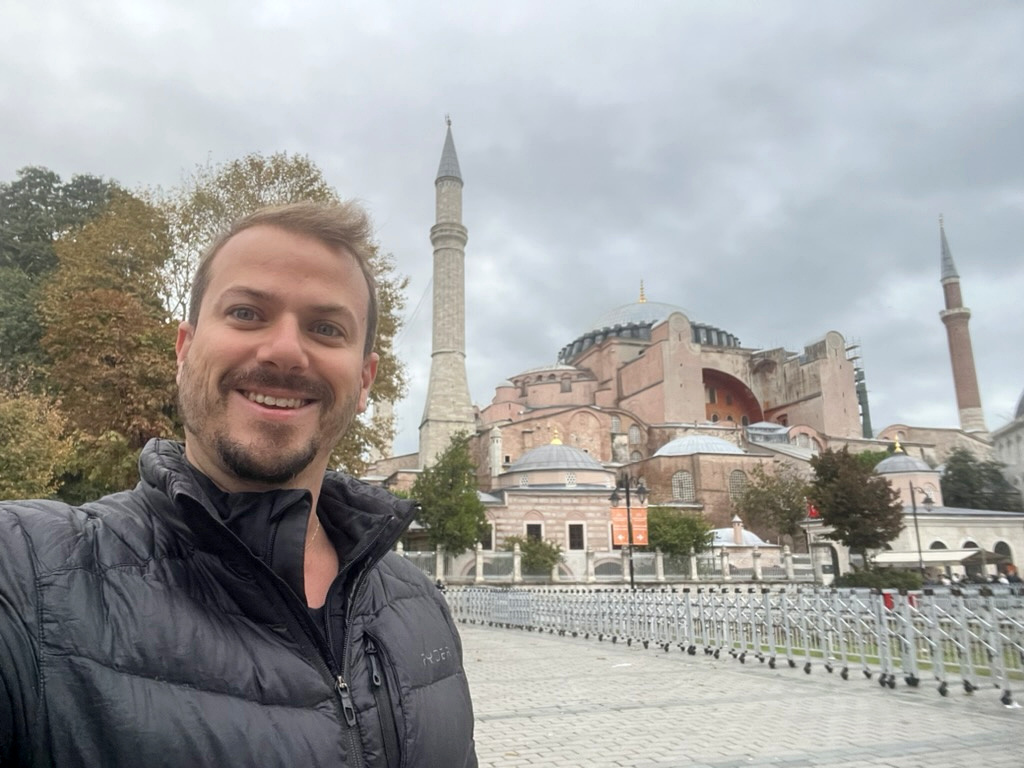
Even before going inside, I loved how much history you could read in the building itself. The enormous Byzantine church commissioned by Emperor Justinian was completed in 537; the minarets came after its conversion into an Ottoman mosque in the fifteenth century. Seeing those different eras together from outside made the experience of stepping inside even more meaningful. Hagia Sophia isn’t a monument to just one moment in history: it carries centuries of Constantinople and Istanbul within the same walls.
A face I knew long before I saw it in Istanbul
There is one photograph from that short stay that matters to me far more than the number of hours I spent in Turkey. I grew up with this image of Jesus. Long before I knew much about Byzantine Constantinople, the face was already familiar. So standing beneath the actual mosaic in Hagia Sophia was one of those strange moments when something you have known for years suddenly becomes a real place on the other side of the world.
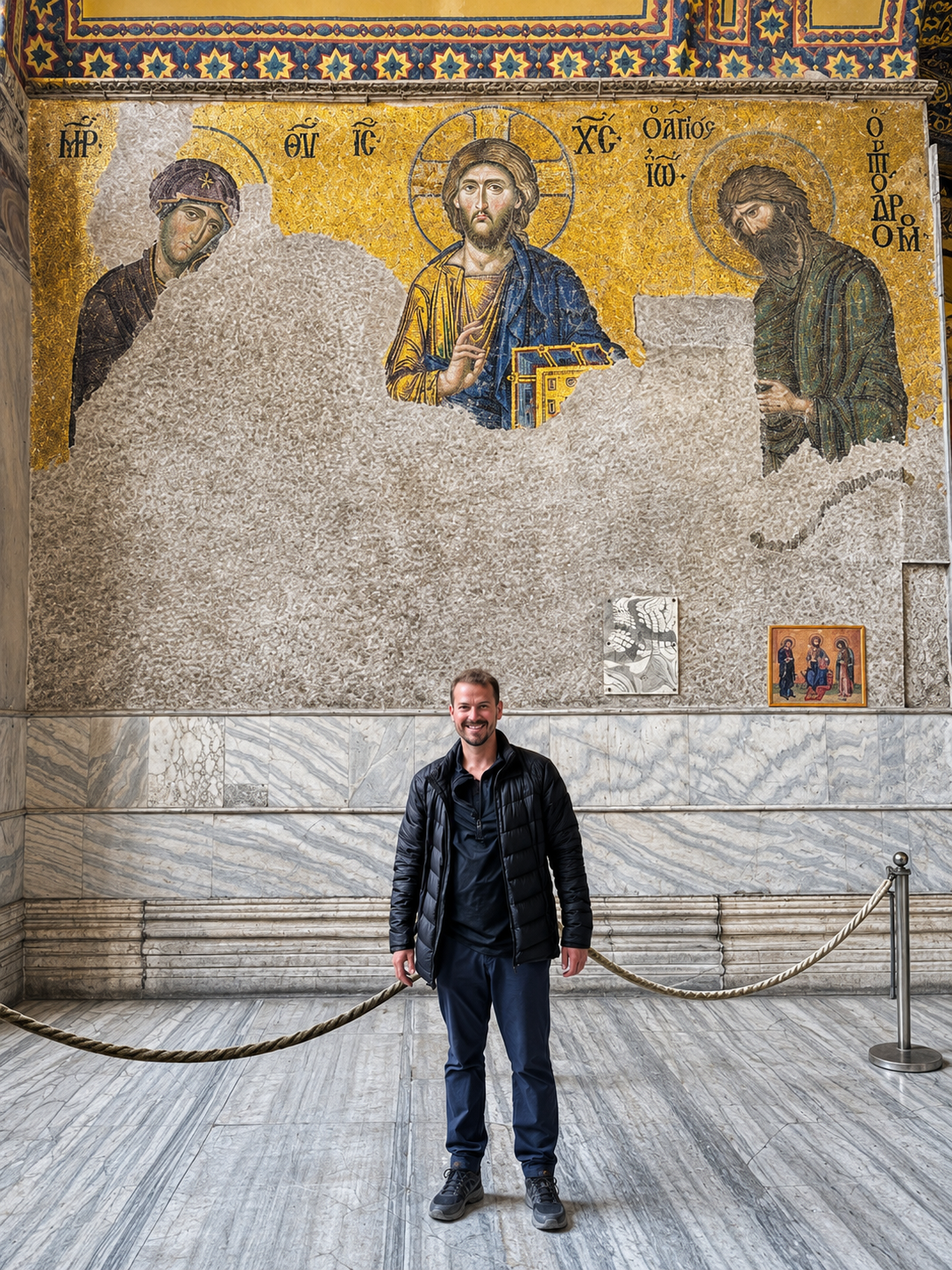
This is the Deësis mosaic, in Hagia Sophia’s upper south gallery. Christ is at the center, blessing with one hand and holding a book in the other. The Virgin Mary and John the Baptist incline toward him, traditionally understood as interceding for humanity. The Greek letters around them identify the figures. It is an extraordinary piece of Byzantine art, probably created in the thirteenth century, in the period after the Byzantines reclaimed Constantinople from Latin rule in 1261. Its precise dating remains a subject of scholarly discussion.
The history of its survival is almost as remarkable as the image itself. Hagia Sophia began as a great Byzantine church and was converted into an Ottoman mosque after the conquest of Constantinople in 1453. Its Christian figural mosaics were eventually concealed beneath plaster or other coverings rather than all being removed outright. Much of this particular panel has been lost, which is why the lower portion looks so starkly different from the gold and figures above. But the surviving sections remained hidden for centuries until the Byzantine Institute’s conservation work brought them back into view in the 1930s. The covering was part of a profound change in the building’s religious use; paradoxically, concealment also helped preserve what we can still see.
What stays with me is the collision of all those layers: a Christian image made in medieval Constantinople, a city conquered and transformed, a work hidden and rediscovered, and a face I recognized from childhood. I travel for these moments as much as for the famous landmarks. Sometimes you cross an ocean and discover that something halfway around the world has been part of your life all along.
For the art history behind the image, see Smarthistory’s analysis of the Deësis and The Metropolitan Museum of Art’s account of its concealment and restoration.
From Saint Sava to Hagia Sophia
I had already seen the Church of Saint Sava in Belgrade, so visiting Hagia Sophia in Istanbul meant more to me than simply checking another famous monument off a list. Saint Sava’s monumental design deliberately drew on Hagia Sophia. I had encountered the later Serbian interpretation first, then finally stood inside the sixth-century original that helped inspire it. I love those moments when places I’ve visited in different countries suddenly connect to one another.
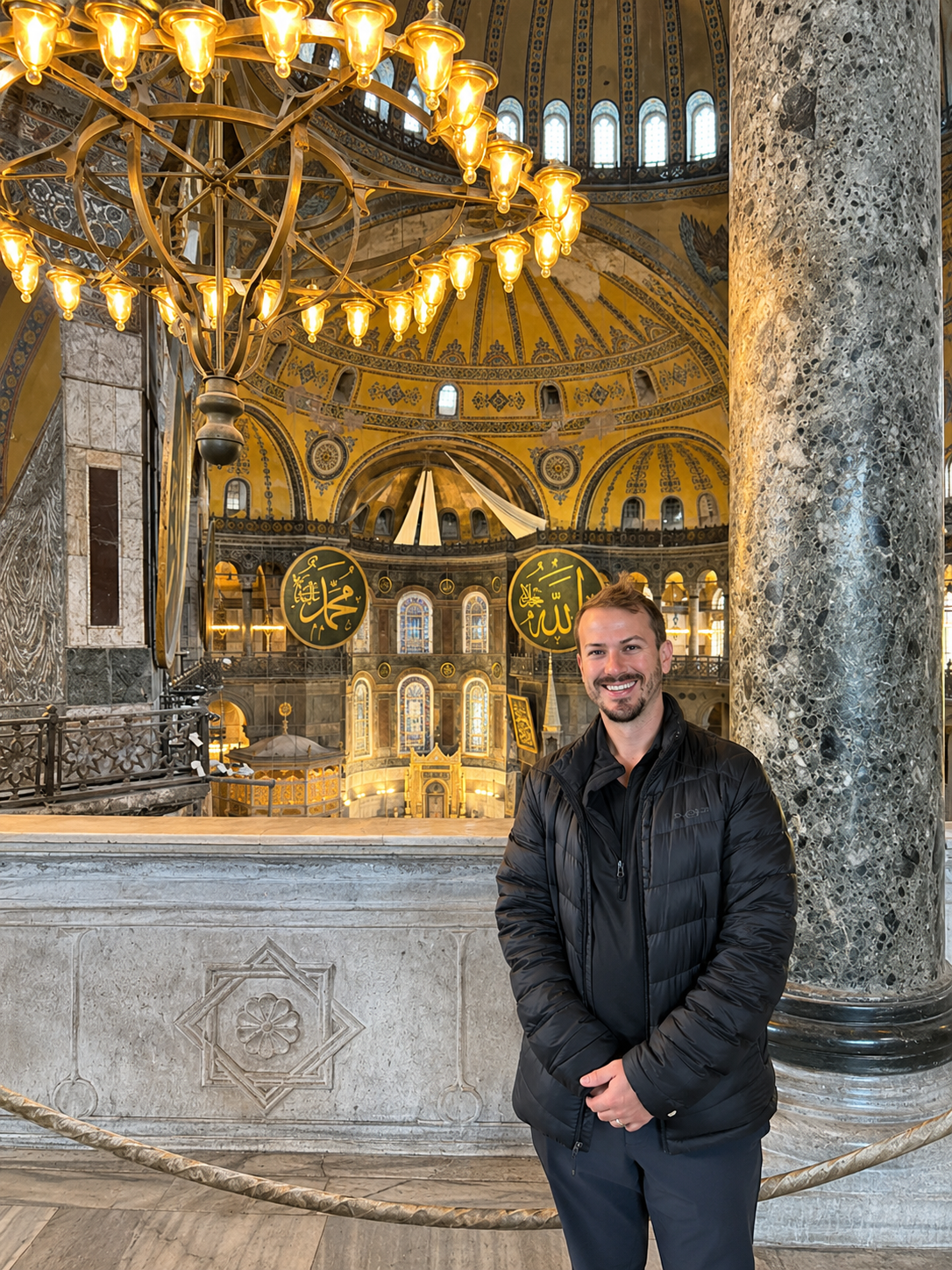
Even its name is worth unpacking: Hagia Sophia means Holy Wisdom in Greek, not a church dedicated to a woman named Saint Sophia. Emperor Justinian’s present building was completed in 537, long before the Ottomans conquered Constantinople in 1453 and converted it into a mosque. It later served as a museum from 1935 until 2020, when it again became a functioning mosque. Looking down from the gallery, I could see the history almost physically layered together: Byzantine vaults and enormous columns, Ottoman chandeliers and monumental Arabic calligraphy, and a building that still serves a religious community today.
Outside Hagia Sophia, I came across another side of Turkish religious life. Worshippers had just finished namaz, the Muslim ritual prayers, and people were handing out coffee and bread. This kind of sharing is sometimes known as ikram, an offering of food or drink that reflects traditions of hospitality and generosity. The bread may have been simit, Istanbul’s famous sesame-covered bread ring, although I can’t say for certain.
Naturally curious, I approached, but some people in line told me it wasn’t for tourists. At first, I assumed this meant it was reserved for Muslims. Looking back, though, I may have misunderstood. Perhaps it was simply intended for the congregation who had just finished praying.
What I find interesting about this little encounter is that Hagia Sophia isn’t merely a historical monument. After nearly 1,500 years of changing empires, religions, and political identities, it remains a living place of worship. I had come to admire its Byzantine mosaics and extraordinary architecture, but just outside, I was reminded that its significance extends well beyond what visitors come to photograph. For the people gathering there, it is also part of everyday religious and community life.
These are the moments I appreciate about traveling: discovering not just the history of a place, but how people continue to live within it.
Historical reading: The Metropolitan Museum of Art on Hagia Sophia’s Byzantine architecture · Research on Hagia Sophia as a model for Serbian architects.
Why I still need to return
Istanbul gave me a genuine introduction to Turkey, but I don’t consider the country finished just because it now counts on my map. There are two experiences in particular that keep calling me back: riding in a hot-air balloon over the extraordinary rock formations and valleys of Cappadocia, and visiting the House of the Virgin Mary (Meryem Ana Evi) near ancient Ephesus, in western Turkey.
The first would be an unforgettable way to see a landscape unlike anywhere I’ve been. The second speaks to the same fascination that brought me to Hagia Sophia’s mosaics: the way places carry the stories of faith, empire and centuries of cultural exchange. The house is revered as a site traditionally associated with Mary’s later life, although that identification is a matter of religious tradition rather than established historical fact. Both are still on my wish list, not places I’ve visited yet.
Does a layover count?
For my World Project, staying inside an airport’s international transit area does not count as visiting a country. Antalya is one of my borderline cases: I passed immigration, went outside the airport and had a coffee in Turkey, but I saw very little. Istanbul is the trip that clearly counts for me — not just because I stayed overnight, but because I made a real effort to spend my limited time experiencing the city, even at the expense of sleep. Turkey counts as one country visited, not two, despite two separate entries.
Places and journeys
- Antalya — approximately 12-hour layover, with a brief outing for coffee, May 2022
- Istanbul — intensive overnight city visit, October 2024
Photographs and future chapters
I’ll add selected photographs from these trips as I work through my archive. This is a living page, not a finished travel guide.
Explore more places
Other country chapters in West Asia and the Eastern Mediterranean: Palestine · Israel. Browse the full West Asia and the Eastern Mediterranean list or explore the travel map.

